

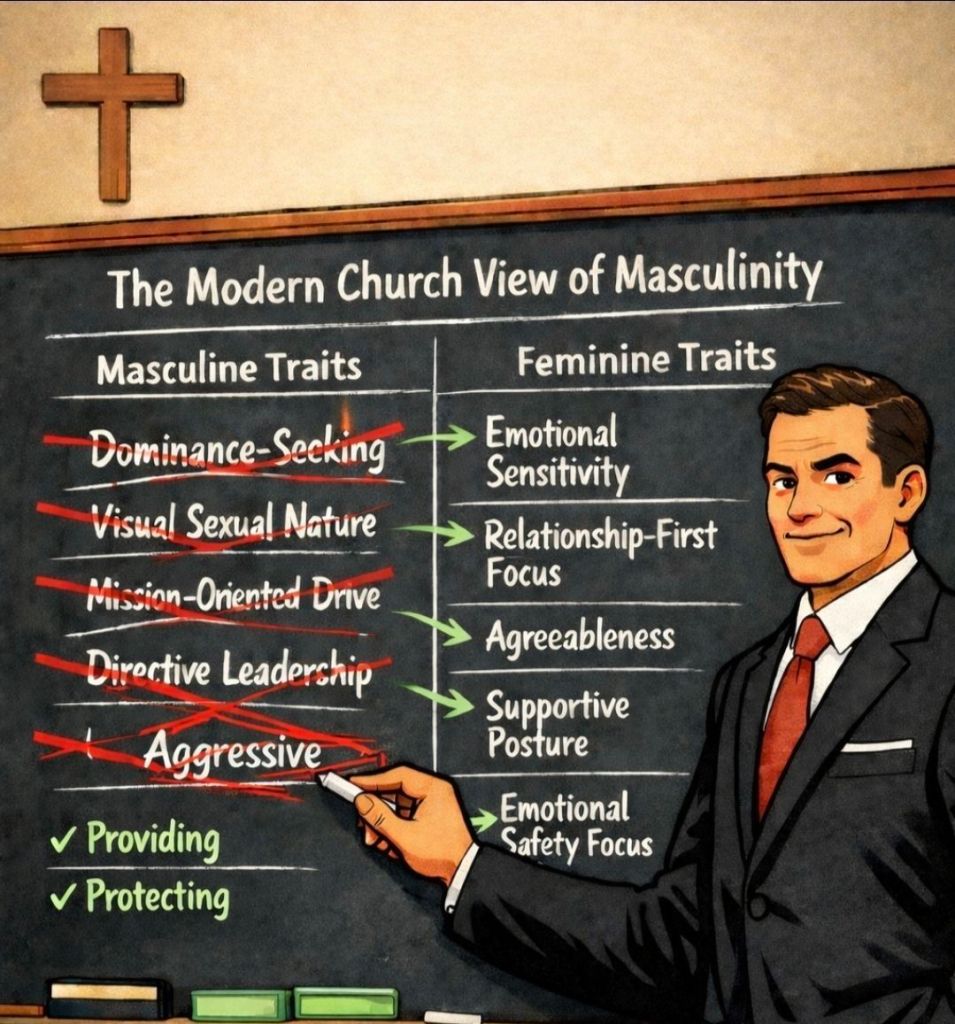
The modern church has quietly redefined virtue. Masculine traits that Scripture affirms — dominance, assertiveness, authority, strength, sexual drive, initiative, and mission focus — are increasingly treated as suspicious, dangerous, or sinful. At the same time, feminine traits such as emotional sensitivity, relational focus, passivity, and agreeableness are elevated as the spiritual ideal for everyone, including men.
The result is not biblical balance. It is role inversion. Men are encouraged to become more like women while still being expected to provide and protect. Masculinity is stripped of authority and purpose and reduced to usefulness alone.
God Created Masculine and Feminine Natures on Purpose
Scripture does not blur the distinctions between men and women. It establishes them at creation and reinforces them throughout redemptive history.
“For a man indeed ought not to cover his head, since he is the image and glory of God; but woman is the glory of man. For man does not originate from woman, but woman from man; for indeed man was not created for the woman’s sake, but woman for the man’s sake.” — 1 Corinthians 11:7–9 (NASB)
God designed man to reflect His masculine authority, initiative, dominion, and leadership. Woman was created from man and for man — not as inferior in worth, but as complementary in role and function.
Scripture also describes the woman as “the weaker vessel” (1 Peter 3:7). This is not an insult. It is a functional description tied to God’s design: women were created with a more relational, nurturing, emotionally oriented nature suited for bearing children, nurturing life, managing the home, and responding to male leadership.
Why God Designed Masculine and Feminine Natures as Polar Opposites
The foundation for masculine and feminine distinction begins in Genesis. God explicitly created woman as a helper for man — not as a duplicate of man and not as a rival to man, but as a complementary counterpart.
“Then the LORD God said, ‘It is not good for the man to be alone; I will make him a helper suitable for him.’” — Genesis 2:18 (NASB)
The Hebrew phrase translated “helper suitable for him” (ezer kenegdo) does not, by itself, specify servitude or subordination. It means a helper who corresponds to him — like him in nature as a fellow human being, yet opposite him in function and orientation. However, the surrounding creation order makes the authority structure clear. God immediately had Adam name the woman, establishing headship. After the Fall, God explicitly placed the woman under the man’s rule (Genesis 3:16). Scripture later calls husbands the “lord” and “master” of their wives (1 Peter 3:5–6). Woman was not created to lead man, but to serve as his subordinate helper — complementary in nature, ordered in authority.
This authority structure was not arbitrary. According to Ephesians 5:22–29, God designed the relationship between man and woman to serve as a living picture of Christ and His people. Man represents Christ in leadership, provision, protection, and sacrificial authority. Woman represents the Church in dependence, submission, service, and trust. Marriage was created to reflect divine order, not merely human companionship. Masculine headship and feminine submission are therefore theological symbols, not cultural inventions.
This design establishes polarity, not sameness. Masculine and feminine natures were intentionally created to differ in orientation, temperament, and role so that together they form a complete household unit — one oriented toward outward dominion and leadership, the other toward inward nurture and preservation.
God did not design masculine and feminine natures as interchangeable variations of the same traits. He created them as deliberate opposites, each ordered toward different spheres of responsibility. This polarity is not a flaw in creation — it is the mechanism by which families, societies, and civilizations function.
What Happens When Feminine Instincts Govern Society
A woman’s empathetic, nurturing, and emotionally responsive nature is a tremendous asset in pregnancy, childbirth, child-rearing, and the management of the home. These traits cultivate life, preserve relationships, and provide emotional stability for children. In these domains, feminine nature excels.
However, those same traits become liabilities in domains that require firmness, hierarchy, coercion, judgment, and the use of force — such as war, criminal justice, national defense, and civil governance. Compassion without authority produces chaos. Empathy without discipline dissolves order.
This is not because women are more sinful than men. All men and women are sinners before God. It is because the feminine nature was designed primarily for managing the affairs of the home and caring for children, not for governing institutions that require judgment, hierarchy, and coercive authority. When empathy becomes the highest virtue in these realms, truth inevitably becomes negotiable.
The same dynamic has overtaken the modern church. Feminine emotional instincts — when unrestrained by masculine authority — have normalized doctrinal compromise, emotional theology, LGBTQ affirmation, victim-centered ethics, and a therapeutic gospel that prioritizes comfort over repentance.
The church did not become soft because men suddenly became more sinful. It became soft because masculine authority was displaced by feminine emotional rule.
Masculine Nature: Designed for Leadership, Dominion, and Mission
From Genesis onward, men are portrayed as initiators, builders, warriors, leaders, and providers. God gave Adam the command before Eve was created. Adam named Eve. Adam was held accountable for the Fall. The pattern is consistent: men are built to move outward into the world, establish order, exercise authority, and create legacy.
Scripture commands men explicitly:
“Be on the alert, stand firm in the faith, act like men, be strong.” — 1 Corinthians 16:13
“Be strong, therefore, and show yourself a man.” — 1 Kings 2:2
Men are not told to become softer, more passive, or more emotionally delicate. They are commanded to be strong, courageous, disciplined, and authoritative.
Feminine Nature: Designed for Nurture, Home, and Support
Scripture repeatedly affirms the feminine role of marriage, childbearing, and household management — not as cultural accidents, but as God’s design.
“Therefore I want younger widows to get married, bear children, keep house, and give the enemy no occasion for reproach.” — 1 Timothy 5:14
“She looks well to the ways of her household and does not eat the bread of idleness.” — Proverbs 31:27
Women are designed for relational investment, nurturing, home-building, emotional connection, and child-rearing. This is not lesser work — it is foundational work. Civilization itself depends on it.
The Bible Condemns the Feminization of Men
While Scripture honors feminine virtues in women, it does not praise feminine behavior in men. In fact, it explicitly condemns male softness and effeminacy.
“Do not be deceived; neither fornicators, nor idolaters, nor adulterers, nor effeminate, nor homosexuals… will inherit the kingdom of God.” — 1 Corinthians 6:9 (KJV)
The Greek word malakoi means soft, unmanly, delicate, lacking masculine firmness. Scripture treats male feminization as moral corruption.
God even describes national judgment in terms of men losing masculine courage:
“A sword against her mighty men… and they will become women.” — Jeremiah 50:37
“In that day the Egyptians will become like women, and they will tremble.” — Isaiah 19:16
Weakness, passivity, fearfulness, and loss of masculine strength are portrayed as shameful consequences of rebellion against God.
Why Men Are Leaving the Church
Men have not abandoned the church because they hate God. They have abandoned the church because the church abandoned masculinity.
When men are told that their strength is dangerous, their sexuality is shameful, their leadership is oppressive, and their authority is abusive by default, they stop seeing church as a place of purpose. The church becomes emotionally driven, conflict-avoidant, and comfort-centered — and men disengage.
This is why most churches today are dominated by women. Not because women are more spiritual — but because modern church culture is structured around feminine social and emotional priorities.
God’s Design Still Stands
God designed men to lead, build, conquer, provide, protect, and establish dominion. He designed women to nurture, support, bear life, cultivate the home, and respond to masculine leadership.
This design is not outdated. It is eternal.
Biblical masculinity is not abuse. It is strength under discipline. Authority under accountability. Leadership under God. Until the church stops apologizing for masculinity and starts teaching men to become strong, ordered leaders again, it will continue to lose them.
The problem is not masculinity. The problem is a church that has become uncomfortable with it.


 Biblical Gender Roles
Leave a comment