

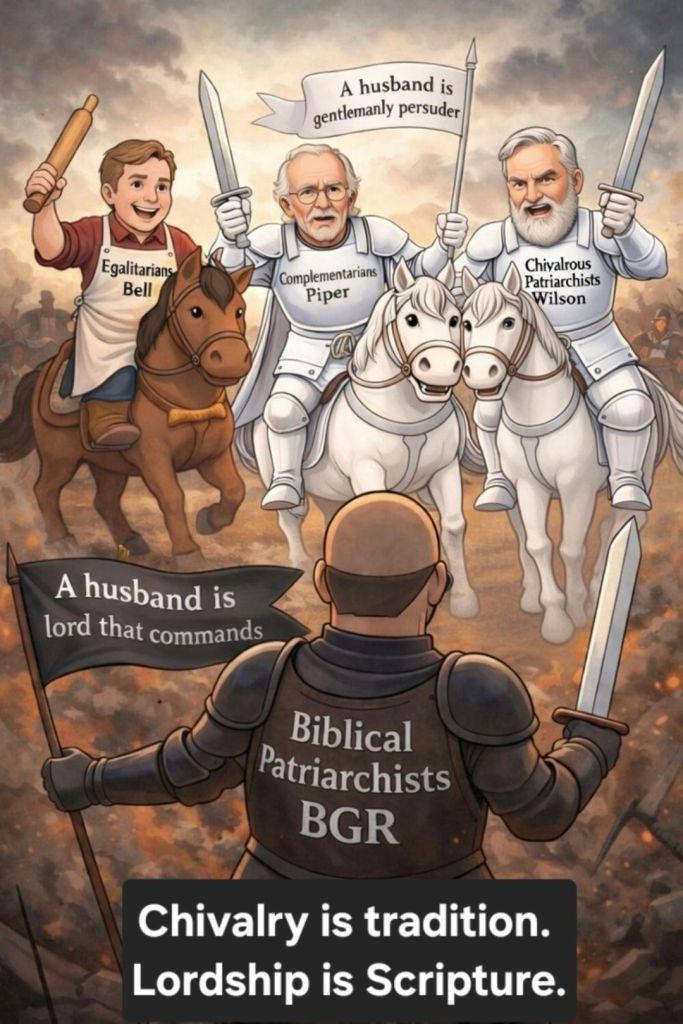
Doug Wilson recently stated that a husband is an honored guest in his own home who should conform himself to the pattern established by his wife and “do as he is told,” and that the husband is “not the boss man.” (Source: Doug Wilson, How to Exasperate Your Wife, Canon Press)
This statement is not an isolated comment. It reflects a consistent theological pattern in Wilson’s teaching — one that reframes biblical headship through the lens of gentlemanly chivalry rather than governing authority.
A husband who is a “guest” in his own home is not a ruler.
A man who “does as he is told” is not exercising headship.
And a man who is “not the boss” is not functioning as the biblical head of his household.
The Gentleman Model Behind Wilson’s Theology
Doug Wilson frequently promotes what he calls “old-fashioned” and “gentlemanly” masculinity. While this sounds virtuous, chivalry is not a biblical category. It is a medieval honor framework that elevates women socially and emotionally while restraining male authority into courtesy and persuasion.
This framework becomes explicit in Wilson’s teaching on submission.
In his article “21 Theses on Submission in Marriage” (dougwils.com), Wilson writes:
“The Bible does not teach husbands to enforce the requirement given to their wives. Since true submission is a matter of the heart, rendered by grace through faith, a husband does not have the capacity to make this happen. His first task is therefore to love his wife as Christ loved the church. He is to lead by example.”
Wilson explicitly rejects enforcement, compulsion, or corrective authority in marriage. Leadership becomes emotional influence rather than rule.
Yet Wilson also teaches strong covenant responsibility.
In his book Federal Husband (Canon Press), he writes:
“One of the most difficult things for modern men to understand is how they are responsible for their wives… the husband is responsible for all the problems. This is the case for no other reason than that he is the husband.”
This creates an unavoidable contradiction:
How can a man be held responsible for someone he is forbidden to correct, command, or discipline?
Responsibility without authority is not biblical leadership. It is symbolic headship.
Christ’s Love Is Not Passive Influence
Wilson regularly appeals to Christ’s love for the church as the model for husbands. But Scripture itself defines what Christ’s love looks like:
“Those whom I love, I reprove and discipline. Therefore be zealous and repent.”
— Revelation 3:19 (NASB)
Biblical love is not sentimental indulgence.
It is corrective.
It disciplines for holiness.
If Christ’s love includes rebuke and discipline, then a husband modeled after Christ cannot reject correction as “unchristlike.” The problem is not Scripture — it is chivalry.
Biblical Headship Predates Chivalry by Thousands of Years
Biblical patriarchy is not rooted in medieval Europe or even in earlier Roman culture. It is rooted in creation.
Before the Fall, Adam exercised authority by naming the woman:
“She shall be called Woman, because she was taken out of Man.”
— Genesis 2:23
In Scripture, naming is an act of dominion (Genesis 1:26–28). Adam did not become head because of sin — he already was.
After the Fall, God reaffirmed this order:
“Your desire shall be for your husband, and he shall rule over you.”
— Genesis 3:16
This was not the creation of male authority. It was the judicial reinforcement of an authority Adam failed to exercise when he stood silently while his wife transgressed.
The New Testament continues this pattern:
“Sarah obeyed Abraham, calling him lord…”
— 1 Peter 3:6
This is not cultural accommodation.
It is covenant continuity.
Wilson Is Not Alone: Piper and Bell Agree on Gentle Persuasion
Doug Wilson is often portrayed as radically different from mainstream evangelical teachers. In practice, however, he shares a key assumption with both complementarians and egalitarians.
John Piper
John Piper teaches that husbands must never compel submission and must lead primarily through sacrificial influence rather than authority.
From Piper’s article “The Meaning of Headship” (desiringgod.org):
“A husband’s leadership is not a right to command and control, but a calling to serve and sacrifice.”
Rob Bell
Rob Bell openly rejects hierarchical authority in marriage altogether, reframing marriage as emotional partnership.
From Bell’s book Love Wins:
“Submission is mutual. Authority is shared.”
Though these men differ theologically, they agree on one core principle:
Men should persuade, not command. Influence, not govern. Suggest, not rule.
This is not biblical patriarchy.
It is chivalric masculinity baptized with Christian language.
Protection: Where the Real Divide Exists
Both Wilson and biblical patriarchists affirm that husbands must protect their wives — but they define protection very differently.
Chivalrous Protection Means:
- Shielding women from discomfort
- Shielding women from rebuke
- Shielding women from firm authority
- Shielding women from accountability
Biblical Protection Means:
- Shielding women from injustice
- Shielding women from exploitation
- Shielding women from predators
- Shielding women from spiritual deception
But not shielding women from truth.
“Faithful are the wounds of a friend.”
— Proverbs 27:6
A husband who refuses to correct his wife is not protecting her.
He is abandoning leadership.
The “Honored Guest” Husband Is Not Biblical
Doug Wilson’s “honored guest” husband is the logical outcome of chivalrous patriarchy:
- Authority without enforcement
- Responsibility without control
- Headship without command
- Leadership without governance
Scripture never describes the husband as a guest in his own home.
It describes him as:
- Head (Ephesians 5:23)
- Lord (1 Peter 3:6)
- Governor of his household (1 Timothy 3:4–5)
The Bible does not call men to become courtly knights.
It calls them to rule their households under God.
Final Word
White knights defend honor culture.
Biblical patriarchists defend God’s order.
Chivalry restrains male authority.
Scripture commands it.
Tradition teaches gentlemanly persuasion.
The Bible teaches headship and lordship.


 Biblical Gender Roles
Leave a comment