

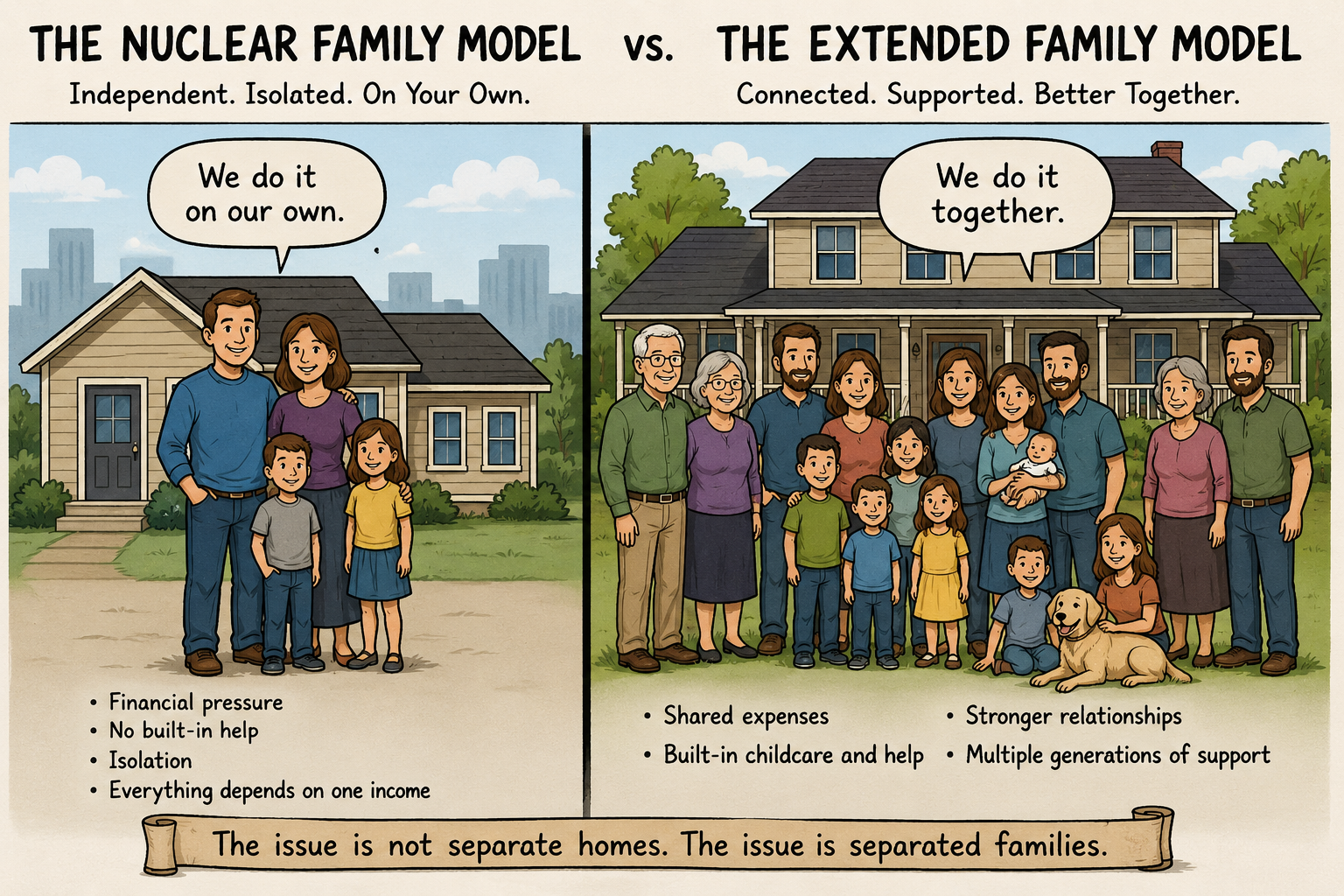
Many Christians assume that the independent nuclear family is God’s design for society. By this they mean a husband, wife, and children living separately from parents, grandparents, siblings, and other relatives.
In contrast, the extended family model consists of multiple generations living together or remaining closely connected while sharing resources, responsibilities, and family life.
Most modern Christians assume the nuclear family model is the biblical ideal and view the extended family model as unusual or even unhealthy. But Scripture never makes this distinction. While the Bible recognizes independent households, it repeatedly presents family life as deeply interconnected across generations.
The problem is not separate homes. The problem is separated families.
The Bible Does Not Command Family Independence
One of the most common arguments for the modern nuclear family model comes from Genesis 2:24:
“Therefore shall a man leave his father and his mother, and shall cleave unto his wife: and they shall be one flesh.”
Many Christians read this verse as teaching that a newly married couple must establish complete independence from their parents. But that is not what the text says.
Leaving father and mother refers to a transfer of primary loyalty. A man’s first earthly obligation is no longer to his parents but to his wife. Yet nowhere does this passage require geographical separation, financial independence, or the severing of family ties.
Throughout biblical history, married couples often remained closely connected to their parents and extended families. Genesis 2:24 establishes a new family unit, but it does not establish family isolation.
The Biblical Household Was Part of a Larger Family Structure
When we read the Bible, we often picture modern suburban families living independently from everyone else. But that is not how ancient Israel was structured.
God organized Israel around tribes, clans, and fathers’ houses. Individuals belonged to households, but those households existed within larger family networks.
Abraham’s household was not an isolated husband and wife with a few children. Jacob’s household was not an isolated nuclear family. Throughout Scripture, family life was interconnected, multi-generational, and communal in ways that are largely foreign to modern Western culture.
The biblical household was a real household, but it was rarely an isolated household.
Adult Children Living With Their Parents Is Not Unbiblical
One of the assumptions produced by modern Western culture is that children should leave their parents’ home as soon as they reach adulthood. Many parents view it as a failure if their children are still living at home in their late teens or twenties.
I did not always hold this view. Like many Christians, I once assumed that successful adulthood required moving out of one’s parents’ home as quickly as possible and that married couples should always establish their own separate household. But the more I studied Scripture and the history of family life, the more I realized that I had confused a modern Western expectation with a biblical principle.
Throughout most of human history, young adults commonly remained in their parents’ households until marriage. In many cases, newly married couples continued living with parents or other extended family members. This pattern was common throughout the ancient world and remains common in many cultures today.
Some argue that a married man who lives with his parents is failing to provide for his wife. But this assumes that providing for one’s wife requires maintaining a completely separate household. Scripture never makes that claim.
A husband can fulfill his obligation to provide while pooling resources with parents, siblings, or other relatives under the same roof. Sharing a dwelling does not mean he is failing to support his wife. In many cases, it may be a wise and responsible way for an extended family to care for one another while reducing financial burdens for everyone involved.
Yet many modern Christians treat moving out at eighteen as if it were a biblical command.
Scripture never requires unmarried adult children to establish independent households. Nor does it teach that remaining in one’s parents’ home is a sign of immaturity or failure.
Certainly there are situations where an adult child should move out. An adult son who refuses to work, refuses responsibility, and merely wishes to prolong adolescence is not following a biblical pattern. But that is very different from a responsible young man or woman who remains with family while preparing for marriage, building financial stability, pursuing education, helping with family responsibilities, or saving for a future household.
The biblical question is not, “Have they left home yet?” The biblical question is whether they are growing into responsible adulthood.
In many cases, allowing adult children to remain connected to their family while they prepare for the next stage of life is far wiser than forcing them into unnecessary financial hardship simply to satisfy a modern cultural expectation.
The idea that every child must be pushed out of the nest at eighteen may be a modern value, but it is not a biblical one.
Scripture Assumes Ongoing Family Obligations
The Bible repeatedly teaches that our responsibilities extend beyond our spouse and children.
Paul wrote:
“But if any provide not for his own, and specially for those of his own house, he hath denied the faith, and is worse than an infidel.” (1 Timothy 5:8)
The context of 1 Timothy 5 is the care of widows and elderly family members. Paul expected children and grandchildren to care for aging relatives rather than shifting that responsibility to the church.
This principle runs throughout Scripture. Family responsibility does not end with your wife and children.
God designed families to support one another across generations.
How Modern Society Drifted Away From This Model
The isolated nuclear family is largely a product of modern economic and social developments.
Industrialization moved people away from family land and family businesses. Urbanization scattered relatives across cities and states. Government welfare programs gradually replaced many of the functions once performed by extended families.
Over time, Western culture transformed independence into a moral virtue.
Today many people believe that adulthood means needing no one, depending on no one, and living entirely apart from family influence. Yet Scripture never presents radical independence as a godly goal.
The Bible values responsibility, maturity, and leadership. But it also values family loyalty, family obligation, and family interconnectedness.
Separate Homes Are Biblical. Isolated Families Are Not.
None of this means that multiple generations must live under one roof.
Scripture contains examples of separate households. There is nothing sinful about a married couple establishing their own home. In many situations, having a separate household may be wise and practical.
But we should not confuse a separate household with an isolated family.
The biblical pattern is not radical independence. It is interdependence.
Parents help children. Adult children help parents. Siblings help one another. Grandparents assist with grandchildren. Families share burdens, resources, wisdom, and responsibilities.
This is how families functioned for most of human history, and it is the model most consistent with Scripture.
Conclusion
The Bible allows both the extended family model and the independent nuclear family model. Scripture does not require every married couple to live with parents or other relatives, nor does it require every family to establish complete independence from them.
What the Bible consistently promotes is family interconnectedness across generations. Parents, children, grandparents, and other relatives are expected to care for one another, support one another, and bear one another’s burdens.
The modern world often treats independence as the highest family value. Scripture does not. While separate households can be wise and practical, the Bible never presents family isolation as an ideal.
Likewise, Scripture does not require parents to push their adult children out of the home at a certain age, nor does it require young adults to establish independent households before marriage. In many cases, it may be financially wiser for adult children to remain with their family while building savings, preparing for marriage, pursuing education, or helping with family responsibilities.
There is also nothing inherently wrong with a newly married couple beginning their life together in an extended family household. Throughout history, many young couples started out living with parents or other relatives while building a financial foundation for the future. A husband can still faithfully provide for his wife while sharing a home and pooling resources with extended family members.
The issue is not whether a family lives in an extended family household or an independent nuclear family household.
The issue is whether families remain connected and faithful to their responsibilities toward one another.
The issue is not separate homes.
The issue is separated families.


Leave a Reply